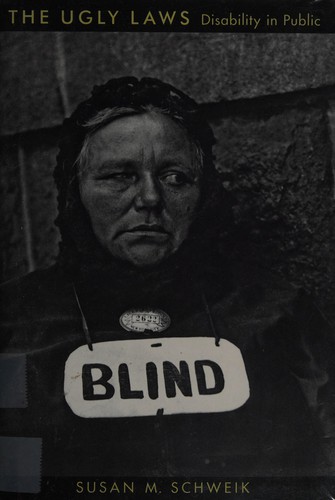
The ugly laws
The murky history behind municipal laws criminalizing disability In the late-nineteenth and early-twentieth centuries, municipal laws targeting "unsightly beggars" sprang up in cities across America. Seeming to criminalize disability and thus offering a visceral example of discrimination, these “ugly laws” have become a sort of shorthand for oppression in disability studies, law, and the arts. In this watershed study of the ugly laws, Susan M. Schweik uncovers the murky history behind the laws, situating the varied legislation in its historical context and exploring in detail what the laws meant. Illustrating how the laws join the history of the disabled and the poor, Schweik not only gives the reader a deeper understanding of the ugly laws and the cities where they were generated, she locates the laws at a crucial intersection of evolving and unstable concepts of race, nation, sex, class, and gender. Moreover, she explores the history of resistance to the ordinances, using the often harrowing life stories of those most affected by their passage. Moving to the laws’ more recent history, Schweik analyzes the shifting cultural memory of the ugly laws, examining how they have been used—and misused—by academics, activists, artists, lawyers, and legislators.
Published: May 1, 2009
Pages: 448
ISBN: 9780814740880
Get This Book
Available in: Ebook, Digital, Paperback, Hardcover
See all editions (4)